By Sarah Bronson, updated Aug 30, 2022
Earth circles the Sun once every 365 days, which is why a year has 365 days. The tilt of Earth’s axis means that, during its orbit, different parts of the planet get more direct sunlight, creating the seasons. The Sun supplies nearly all of Earth’s energy; without it, the planet would be a cold, lifeless world, and without its gravity, Earth would drift off into space.
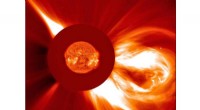
The Romans called the Sun “Sol,” which is also the root of the word “solar system.” The Sun is not a solid body you could stand on; it is a giant ball of hot gases—mostly hydrogen and helium. These gases spin around just like Earth does, completing one full rotation in about 26 days. This rapid spin creates the powerful magnetic field that drives solar flares and sunspots.
The average distance from Earth to the Sun is about 150 million kilometres (93 million miles). If you could drive straight to the Sun at 96.6 km/h (60 mph), the trip would take roughly 177 years! Light, however, travels this distance in only 8 minutes, which is why we see the Sun’s light almost instantaneously.
All the matter in the Solar System—planets, moons, asteroids, comets—makes up only 2 percent of the total mass. The Sun accounts for a staggering 98 percent. Its radius is more than 100 times the radius of Earth, and its mass is over 330,000 times greater than our planet’s. That’s why the Sun’s gravity keeps everything else in orbit.
Earth’s average surface temperature is about 16 °C (61 °F). In contrast, the Sun’s surface (the photosphere) reaches about 5,700 °C (10,292 °F). As you move outward from the surface into the Sun’s atmosphere (chromosphere and corona), temperatures rise to millions of degrees because hot plasma rises while cooler material sinks. The Sun isn’t actually “on fire”; it generates energy through nuclear fusion, converting hydrogen into helium and releasing vast amounts of heat and light.
Learn more from NASA’s Solar System Exploration page: NASA – The Sun.