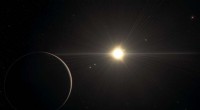
Venus is the second‑closest planet to the Sun and, from Earth, the brightest object in the night sky after the Moon. Its dense, cloud‑covered atmosphere reflects sunlight with remarkable efficiency, making it a striking “Evening Star” or “Morning Star” depending on its position in its orbit.
When Venus is at its peak brightness, its magnitude reaches –4.6, outshining all other planets. Even unaided eyes can spot it as a bright, colorless point of light just west of the Sun after sunset or east of the Sun before sunrise. During certain times of the year, Venus can also be seen during daylight hours by observers trained to look for its bright spot near the Sun. At its brightest, Venus can even cast faint shadows on the ground during twilight, a rare optical phenomenon. For a closer look, binoculars or a small telescope reveal surface details and atmospheric bands.
Because Venus never strays far from the Sun, it appears only within a few degrees of the horizon after sunset or before sunrise. Track its angular distance from the Sun: when it reaches maximum elongation (about 47°), it can be visible well after sunset or before sunrise, depending on the season.
Like the Moon, Venus shows a full set of phases as its relative positions to Earth and the Sun change. A crescent Venus is closer to Earth and therefore appears larger and brighter. A small telescope or high‑powered binoculars will display the familiar crescents, gibbous, and “full” Venus.
Consult reputable sources such as NASA’s Venus page or the JPL Horizons system for precise positions, elongations, and phase information. Astronomy software and mobile apps also provide real‑time alerts.