Samere Fahim Photography/Getty Images
Neptune and Uranus, the seventh and eighth planets from the Sun, share many traits typical of ice giants. Though Neptune appears bluer and Uranus a pale cyan, they both measure just over 30,000 miles (≈50,000 km) across and weigh roughly the same—Neptune at 1.024 × 10^26 kg (≈17 × Earth) and Uranus at 8.682 × 10^25 kg (≈14 × Earth). Their upper atmospheres are dominated by hydrogen, helium, and methane.
Recent research suggests these distant worlds may host colossal oceans that dwarf Earth’s deepest trenches, offering a new perspective on planetary science.
Earth’s oceans cover about 70 % of its surface, yet only 26.1 % of the seafloor has been mapped (Nippon Foundation‑Gebco, June 2024). The Challenger Deep in the Pacific reaches 35,876 ft (≈6.8 mi). While life in these extreme environments is still largely a mystery, the depths of Neptune and Uranus could be orders of magnitude greater.
Buradaki/Getty Images
In a study published in the Proceedings of the National Academy of Sciences, planetary scientist Burkhard Militzer (UC Berkeley) used molecular dynamics simulations to show that both Uranus and Neptune likely contain water‑rich layers roughly 5,000 mi deep—about 715 times deeper than Earth’s Challenger Deep. The simulations, involving 540 atoms, reveal that high pressure separates the interior into an upper, water‑rich layer and a lower, hydrocarbon‑dominated one.
With only the 1986 Voyager 2 flybys providing detailed data, this finding adds a vital piece to the puzzle of the outer planets.
buradaki/Shutterstock
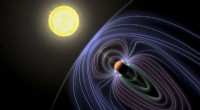
Voyager 2 discovered that Uranus’ magnetic field is tilted 59° from its rotational axis and offset from the core by about one‑third of its radius—no dipole field like Earth’s. Neptune’s field is tilted 47° and similarly displaced. This contrasts with Earth, where convection in a molten iron‑nickel core generates a dipole aligned within ~10–11° of the rotation axis.
The absence of a dipole on Uranus and Neptune suggests that their inner layers do not convect or mix as in terrestrial planets, a mystery that Militzer’s layered model helps to explain.
buradaki/Shutterstock
Militzer’s earlier simulations with 100 atoms failed to produce distinct layers. The latest 540‑atom model now shows a clear separation: a 5,000‑mi water‑rich upper layer, a 5,000‑mi hydrocarbon‑rich lower layer, and a dense core—Mercury‑size for Uranus and Mars‑size for Neptune.
This structure supports the lack of a magnetic dipole and hints at the complex internal dynamics of the ice giants.
Mikadun/Shutterstock
These 5,000‑mi oceans exist under pressures ~60,000 times Earth’s surface pressure, forming supercritical fluids—high‑pressure gases that behave like both liquids and gases. Though the composition differs from Earth's water, the sheer depth and density make them as fascinating as any terrestrial ocean.
Below the supercritical water layers lie the hydrocarbon‑rich strata, which in turn rest atop the planet’s core. Together, they paint a picture of complex, layered interiors that remain largely unexplored.