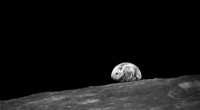
Taro Hama @ E‑kamakura/Getty Images
As Earth orbits the Sun, its constant companion—the Moon—tugs the oceans, creating the tides we observe today. When life first appeared on Earth, the Moon was already a familiar presence. Yet this partnership is relatively recent in cosmic terms; Earth did not always have a satellite.
Our best model of the Solar System’s birth begins with a diffuse cloud of gas and dust—a nebula—collapsed under gravity to form the Sun. The surrounding disk of material coalesced into planets, moons, and smaller bodies. By dating meteorites, scientists estimate the Sun and Earth formed roughly 4.6 billion years ago. Radiometric dating of lunar samples returned ages of up to 4.46 billion years, showing the Moon is nearly as old as Earth and perhaps a touch older.
Stocktrek Images/Getty Images
Several hypotheses attempt to explain the Moon’s origin. Any credible model must satisfy five criteria: the Earth–Moon angular momentum, the Moon’s mass and density, the Moon’s tiny iron core, the depletion of volatile elements, and the chemical similarity between the two bodies.
The prevailing theory, championed by NASA and most planetary scientists, proposes that a Mars‑sized body—named Theia—collided with the early Earth. This impact stripped away outer layers, imparting the system’s angular momentum, creating a small core for the protomoon, and ejecting material that later coalesced into the Moon.
Mariusz Lopusiewicz/Shutterstock
Isotopes—atoms of the same element with different neutron counts—act as fingerprints of planetary material. Oxygen has three stable isotopes (¹⁶O, ¹⁷O, ¹⁸O). Measurements reveal that lunar rocks have the same oxygen isotope ratios as Earth, implying a shared source. However, impact simulations predict that most lunar material would derive from Theia, which should exhibit distinct isotopic signatures. This mismatch, known as the “isotopic crisis,” remains unresolved.
South_agency/Getty Images
Earlier ideas—such as a rapid early spin flinging material outward (George Darwin, 19th century) or co‑formation with Earth—do not align with the Moon’s small core or its observed composition. More recent alternatives suggest Theia had an Earth‑like isotopic makeup, or that post‑impact vapor mixing homogenized the material. Neither hypothesis fully explains the data.
With current knowledge, the Moon’s exact formation pathway remains uncertain. Upcoming missions may offer clarity. NASA’s Artemis program plans crewed lunar landings as early as 2027, promising new samples and observations that could finally resolve the isotopic mystery.