NASA/JPL‑Caltech/MSSS
Mars remains a world inhabited solely by robotic explorers, a testament to humanity’s most ambitious technological endeavor: launching machines that can operate 140 million miles from Earth. In August 2012, NASA’s Curiosity rover landed in Gale Crater, a basin carved by a meteor impact 3.7 billion years ago. The crater’s centerpiece, Mount Sharp, presented a unique landscape that guided the selection of this landing site.
Designed to survive two years on the Martian surface, Curiosity has far outlived expectations, remaining active and in excellent condition. Its longevity stems from superb engineering and a suite of ten scientific instruments, including the ChemCam laser that vaporizes samples for spectrographic analysis, the Sample Analysis at Mars (SAM) suite that detects organic molecules, and a high‑resolution camera system that captures detailed images of the terrain.
Over its decade‑plus mission, the rover has delivered remarkable insights into Mars’ history, from evidence of ancient lakes to the detection of organic compounds and seasonal methane fluctuations. These discoveries have reshaped our understanding of the Red Planet and guided future exploration strategies.
One of Curiosity’s most transformative findings came in 2018 when the SAM instrument suite identified complex organic molecules—such as thiophenes, benzene, and short carbon chains—in mudstone samples from Gale Crater. These compounds are fundamental building blocks of life, though their presence alone does not confirm past life on Mars. They could result from ultraviolet‑induced reactions between atmospheric CO₂ and surface materials.
Regardless of origin, the detection is monumental. If life ever existed on Mars, these organics would be key evidence of its chemical history. NASA’s Goddard Space Flight Center investigators, Charles Malespin and Amy Mcadam, consider this the rover’s most significant find to date.
In 2023, Curiosity uncovered wave‑rippled textures within the Marker Band—a colored rock stripe on Mount Sharp. These ripples, preserved in ancient strata, signal that shallow lakes once existed in an area now expected to be dry. A 2025 study in Science Advances argued that the patterns formed from wind‑driven waves in open water about 3.7 billion years ago, indicating that Mars once supported a hydrological cycle capable of sustaining liquid water.
This discovery enriches our understanding of Gale Crater’s geological evolution, suggesting that the crater’s sedimentary layers were deposited by extensive drainage networks and water flows.
On May 30 2024, Curiosity fractured a rock on the Martian surface, revealing pure sulfur crystals—a surprise, as the region typically hosts sulfate minerals. Curiosity’s 2,000‑pound mass and 10‑foot length allowed it to crush the specimen, a capability reminiscent of the Spirit rover’s experience with wheel damage.
Curiosity scientist Ashwin Vasavada told CNN that this “strangest” find might hint at a broader sulfur distribution across the area. The discovery underscores the importance of examining rover‑induced disturbances to uncover unexpected geologic features.
Curiosity has monitored methane concentrations in Gale Crater’s atmosphere using the SAM tunable laser spectrometer since 2012. The planet’s methane exhibits puzzling behavior—peaking at night and fluctuating with seasons. The highest readings, recorded in 2019, were not detected by ESA’s ExoMars Trace Gas Orbiter, raising questions about methane’s source and retention.
A 2024 paper in the Journal of Geophysical Research: Planets proposes that methane may be trapped under solid salt layers that release gas when warmed by the rover’s weight or by diurnal temperature changes. This mechanism could explain why methane is predominantly detected near Curiosity’s landing site.
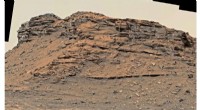
While Mars today is arid, evidence points to a wetter, warmer past. Curiosity’s investigations of Mount Sharp’s hills revealed cyclical water activity—shallow lakes, mud cracks, and debris flows—indicating that water appeared and vanished in distinct phases rather than a gradual decline.
In 2024, the rover studied the Gediz Vallis channel, a valley likely carved by ancient rivers but later filled with debris. The presence of liquid‑water signatures in this late‑stage formation suggests that water returned after extended dry periods, offering a glimpse into the planet’s complex climatic history.