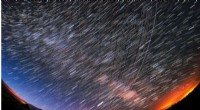
Stargazing, once a cherished pastime, is increasingly lost amid light pollution and digital distractions. Recent studies confirm that observing the night sky benefits mental well‑being, reminding us of the importance of reconnecting with the cosmos.
When we look up, we encounter far more than sun‑like stars. Many of the bright points we see are planets, galaxies, or nebulae—each with its own story. If you’re unsure which you’re watching, the last time you admired a “star” may have been something entirely different.
With early 2025’s planetary alignment still unfolding, now is the perfect time to learn about the brightest non‑stellar objects in the night sky. Because these bodies move, identifying them can be tricky, so we’ll explain when and where you’ll have the best chance to spot each one.
Dean Fikar/Getty Images
Venus, our closest planetary neighbor, ranks as the third brightest object in the sky after the Sun and Moon. In January 2025, it reached an apparent magnitude of –4.4, a level that dwarfs Sirius (–1.6) and is still brighter than a full Moon’s –12.6. That extraordinary brightness is due to three factors: its proximity—about 52 million miles from Earth during the period—its highly reflective cloud deck, which reflects roughly 70 % of incident sunlight, and its waning phase from February to March, which gives it a crescent‑like appearance similar to the Moon’s phases.
Observers in the Northern Hemisphere should look toward the southwestern sky after sunset to find Venus, while Southern Hemisphere viewers should search the western horizon.
BLINKCATCHER/Shutterstock
Jupiter, the gas giant that can accommodate about 1,000 Earths, is the brightest non‑stellar body in the east. Its mass, more than twice the combined mass of all other planets, was assembled from the Sun’s primordial disk some 4.6 billion years ago. Jupiter’s distance from Earth varies between 365 million and 600 million miles, yet it remains visible year‑round. The best view occurs when the planet rises before sunset in the east, then travels southward and sets in the west.
Jupiter shone brightly again in January 2025 and will reach an even brighter apparent magnitude of –2.53 during its 2026 opposition, when it is only 395 million miles away. At opposition, the planet rises with the Sun and follows the Sun’s noon position throughout the day, making it accessible from almost any location.
Derek Berwin/Getty Images
The fourth planet from the Sun, Mars is renowned for its crimson‑gold hue, produced by iron oxides in its soil. In January 2025, Mars achieved its most recent peak brightness with an apparent magnitude of –1.4 during opposition at roughly 60 million miles. The next time Mars will match this brightness is not until February 2027.
During February and March 2025, Mars remains bright in the sky, gradually dimming as the weeks pass. In the U.S. and parts of Canada, it appears in the eastern sky after dark and moves toward the southwest at dawn. Planets tend to follow the ecliptic— the ancient orbital plane of the Solar System—so spotting bright, slightly disc‑shaped objects along the Sun’s daytime path will usually reveal a planet.
Roberto Machado Noa/Getty Images
Saturn, the jewel of the Solar System, remains one of the brightest non‑stellar objects, with a maximum apparent magnitude of 0.43. The Cassini‑Huygens mission provided unprecedented insight before the spacecraft entered the planet’s atmosphere in 2017.
In mid‑January 2025, Saturn appeared in conjunction with Venus in the southwestern sky shortly after sunset. It remained visible through most of February. On February 1, stargazers could observe a spectacular trio: Venus, Saturn, and a faint crescent Moon clustered together. Neptune was also present, though too faint for unaided vision.
Saturn fades as it approaches the Sun toward the end of February but returns in September 2025 at opposition, where it will be the brightest object of the year.
Bl4ckholesun/Shutterstock
Andromeda (M31, NGC 224) is the only galaxy besides the Milky Way visible to the naked eye. Spanning 200,000 light‑years and hosting hundreds of billions of stars, it lies 2.5 million light‑years away, appearing as a faint point of light that can be mistaken for a star. With an apparent magnitude of 3.1, it sits at the edge of unaided visibility but is still discernible even in moderately light‑polluted areas.
In northern latitudes, Andromeda glows in the northwest during fall and winter. To locate it, find the W‑shaped constellation Cassiopeia; the “valley” between its two V‑shaped arms points toward the hazy Andromeda light.
Andromeda is moving toward us at 68 mph and will collide with the Milky Way in roughly 4 billion years, a monumental event that will reshape both galaxies.
Tom O’Reilly/Shutterstock
While nebulae are not typically seen with the naked eye, the Orion (M42) and Carina Nebulae can be detected under optimal conditions, such as during a new moon.
The Orion Nebula lies just below Orion’s Belt in the northern sky (or above it for southern observers). Its ultraviolet‑lit gas glows with the activity of hot stars. The Carina Nebula (Caldwell 92), 7,500 light‑years away, houses stars up to five million times brighter than the Sun, yet its apparent magnitude of 4.8 pushes the limits of unaided visibility; binoculars or a telescope will reveal its colorful structure.
With the right conditions and minimal light pollution, these nebulae offer a glimpse into the birthplaces of stars in our own galaxy.