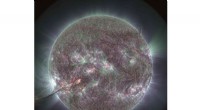
For millennia, scientists have monitored the Sun’s activity to understand its influence on Earth. Modern space‑weather forecasters now track the Sun’s 11‑year solar cycle—characterized by the rise and fall of sunspots and solar flares—to anticipate how solar energy and particles affect our climate and technology. Recent research, however, indicates that the next “battle zone” period, when two Hale cycle magnetic bands clash, could generate even more hazardous space‑weather conditions in 2026‑27.
Researchers at Lynker Space, a leading provider of real‑time space‑weather forecasts, have focused on the magnetic bands that form during the 22‑year Hale cycle. Each Hale cycle comprises two consecutive 11‑year solar cycles, ending with a reversal of the Sun’s magnetic polarity. By mapping these bands, the Lynker team accurately predicted the onset of the current solar maximum in October 2024 and identified the next phase of heightened activity.
During a solar maximum, Hale bands emerge near the Sun’s poles—one in each hemisphere—and gradually drift toward the equator over 17 to 19 years. This migration creates an imbalance that permits sunspots to appear. When the following 11‑year cycle begins, a new set of oppositely polarized bands appears near the poles and converges with the older bands. The resulting interaction reduces the imbalance and suppresses sunspot formation, yet it also triggers a powerful “battle zone” where the magnetic bands collide.
The battle zone is a period of intensified geomagnetic activity that follows the solar maximum. During this time, the Sun emits a high frequency of solar flares, which release magnetic fields and X‑rays that can generate geomagnetic storms on Earth. These storms intensify auroras—even at lower latitudes—and can disrupt power grids, interfere with radio communications, and damage satellites, potentially causing them to deorbit.
More concerning are the large coronal holes that form during the battle zone. These appear as dark patches in soft X‑ray and extreme‑ultraviolet images and are characterized by open, unipolar magnetic fields. They allow solar wind— a continuous stream of charged particles—to escape at higher speeds, increasing the intensity and prevalence of geomagnetic disturbances. Lynker Space warns that even low‑orbit satellites and ground‑based operators should remain vigilant during this period.
Combined, the surge in solar flares and coronal holes could produce geomagnetic storms comparable to the 1859 Carrington Event, one of the most severe space‑weather events recorded. Such storms could threaten modern infrastructure, satellite operations, and aviation, underscoring the importance of monitoring the Sun’s evolving magnetic landscape.