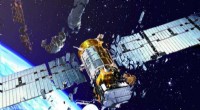
Despite being our home, the Milky Way remains a vast and largely unexplored laboratory. Spanning roughly 100,000 light‑years and hosting several hundred billion stars, its sheer scale makes every discovery feel monumental. Among the most intriguing findings in recent years are the twin bubbles that extend about 50,000 light‑years above and below the Galactic Center, first revealed by NASA’s Fermi Gamma‑ray Space Telescope in 2010 and later confirmed in X‑rays by the eROSITA instrument aboard the German‑Russian Spektr‑RG mission in 2020.
These structures—often referred to as the Fermi and eROSITA bubbles—present a symmetric, balloon‑like shape that hints at a violent event deep in the Milky Way’s past. Yet their true origin remains debated, with leading theories pointing to either a powerful outburst from our central supermassive black hole or an ancient episode of intense star formation.
One compelling explanation attributes the bubbles to a massive accretion episode of Sagittarius A*, the supermassive black hole that resides at the Galactic Center. Roughly 2.6 million years ago, it is proposed that the black hole ingested a substantial amount of material, launching twin, high‑energy jets perpendicular to the galactic plane. These jets would have injected cosmic rays into the surrounding medium, inflating the bubbles we now observe.
In a 2022 study published in Nature Astronomy, researchers performed numerical simulations incorporating gravitational dynamics, interstellar gas flows, and cosmic‑ray physics. Lead author Hsiang‑Yi Karen Yang explained that the jets generate shock fronts that propel gas outward, producing the X‑ray emission detected by eROSITA while simultaneously powering the gamma‑ray glow captured by Fermi. The close agreement between the simulated bubble morphology and the actual observations lends strong support to the black‑hole‑jet model.
An alternative scenario envisions the bubbles as the aftermath of a historic starburst—an era of rapid, massive star formation at the heart of the Milky Way. During such an event, dense gas clouds collapse to form numerous short‑lived, high‑mass stars. Their stellar winds and supernova explosions would collectively drive a powerful galactic wind, carving out the observed bubble‑like cavities.
While this model can account for the overall energetics, recent comparisons of its predictions with the detailed spatial and spectral characteristics of the bubbles have favored the black‑hole‑jet mechanism. Nonetheless, ongoing observations and refined simulations continue to test both hypotheses.
Ultimately, the true driver of the Fermi and eROSITA bubbles remains an open question, but each theory offers valuable insights into the dynamic processes that have shaped our Galaxy. Continued multi‑wavelength studies and future missions will help unravel this cosmic mystery.