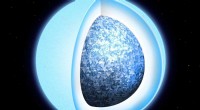
Our Sun may appear as an endless glow of hot gas, yet its destiny is finite. While the eventual death of the star may sound bleak for life on Earth, science has uncovered a breathtaking finale: the Sun will transform into a colossal crystal.
The Sun’s energy comes from nuclear fusion. In its core, gravity forces hydrogen atoms together, turning them into helium and releasing vast amounts of energy. This fusion keeps the core stable at about 15 million Kelvin and provides the light and heat that sustains life on Earth. This hydrogen‑burning phase, known as the main sequence, accounts for roughly 90 % of the Sun’s 10‑billion‑year lifespan. We are currently about 4.5 billion years into that period—roughly halfway through its life.
When the core’s hydrogen runs out, the Sun can no longer sustain the outward pressure that balances gravity. The core collapses, its temperature rises tenfold, and the Sun’s core begins to fuse helium. This “helium flash” is expected to occur in about 5 billion years, producing carbon and oxygen and temporarily restoring equilibrium. Subsequent fusion of heavier elements will inflate the Sun into a red giant, possibly engulfing Earth, and it will shed its outer layers to form a beautiful planetary nebula.
What remains is a dense, hot core—a white dwarf—that will shine for billions of years before cooling and fading. Recent observations from the European Space Agency’s Gaia mission have revealed a surprising secret hidden within these stellar embers.
After a white dwarf forms, it radiates the heat stored in its core. Over time, it cools to a point where the carbon and oxygen in its interior undergo a phase transition—much like water freezing, but under far more extreme temperatures and pressures. The result is a giant crystal: a spherical lattice of oxygen nuclei surrounded by a carbon‑rich mantle.
According to lead researcher Pier‑Emmanuel Tremblay of the University of Warwick, all white dwarfs eventually crystallize, with more massive ones doing so sooner. He estimates the Sun will become a crystal white dwarf in roughly 10 billion years.
Tremblay’s team analyzed Gaia data for 15,000 white dwarfs within 300 light‑years. They identified a “pile‑up” of stars with specific colors and luminosities—signatures of the crystallization process. This transition temporarily slows cooling, extending the lifespans of some white dwarfs by up to 2 billion years. The study provides the first direct evidence of stellar crystallization, confirming a prediction made half a century ago.
Crystallized white dwarfs are not merely astronomical curiosities; their quantum‑ordered structure—a metallic oxygen core with a carbon‑rich shell—creates conditions that cannot be replicated in any laboratory on Earth. Each crystal adds to the galaxy’s growing collection of diamond‑like remnants.
The Sun will evolve into a white dwarf in about 10 billion years, once it exhausts the hydrogen in its core.