1. Special Relativity (1905): This theory, based on two postulates:
* The laws of physics are the same for all observers in uniform motion.
* The speed of light in a vacuum is the same for all inertial observers, regardless of the motion of the light source.
This led to several revolutionary consequences:
* Time dilation: Time passes slower for objects moving at high speeds relative to a stationary observer.
* Length contraction: Objects moving at high speeds appear shorter in the direction of motion.
* Mass-energy equivalence (E=mc²): Mass and energy are equivalent and can be converted into each other. This equation is arguably the most famous in physics and has profound implications for nuclear energy and other fields.
2. General Relativity (1915): This theory extends special relativity to include gravity, describing it as a curvature of spacetime caused by mass and energy. Key predictions of general relativity include:
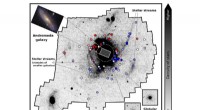
* Gravitational lensing: Light bends around massive objects, causing distant objects to appear distorted or multiple images.
* Time dilation in a gravitational field: Time passes slower in stronger gravitational fields.
* Gravitational waves: Ripples in spacetime caused by accelerating masses. These waves were detected in 2015, providing strong evidence for general relativity.
3. The Photoelectric Effect (1905): This discovery, which earned Einstein the Nobel Prize in 1921, showed that light behaves as both a wave and a particle, now known as photons. It explained how electrons are emitted from a metal surface when light shines on it, contributing to the development of quantum mechanics.
4. Brownian Motion (1905): Einstein explained the random movement of particles suspended in a fluid, providing strong evidence for the existence of atoms and molecules. This work helped solidify the atomic theory of matter.
These are just a few of Einstein's many contributions to science. His groundbreaking work continues to influence scientific research and inspire generations of physicists today.