Kepler's Third Law states that the square of the orbital period of a planet is proportional to the cube of the semi-major axis of its orbit.
Here's why this law is incredibly useful for astronomers:
* Calculating Orbital Periods: Knowing the distance of a planet from its star (the semi-major axis), astronomers can directly calculate the time it takes for the planet to complete one orbit (its period). This is essential for understanding the dynamics of planetary systems.
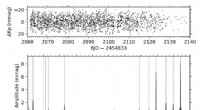
* Discovering New Planets: By observing the wobble in a star's motion (due to the gravitational pull of an orbiting planet), astronomers can use Kepler's Third Law to estimate the orbital period of the unseen planet. This is a crucial tool for finding exoplanets.
* Determining Masses: While Kepler's Third Law doesn't directly provide a planet's mass, it can be used in conjunction with other observations to estimate the mass. This is vital for understanding the composition and structure of planets.
* Understanding Stellar Evolution: Kepler's Third Law helps astronomers understand the evolution of stars and planetary systems. By analyzing the orbital periods of planets around stars of different ages and masses, they can gain insights into how planetary systems form and evolve.
In summary, Kepler's Third Law is a fundamental tool for astronomers studying planets and their orbits. It allows them to calculate orbital periods, discover new planets, estimate masses, and gain insights into the evolution of planetary systems.