Here's a breakdown:
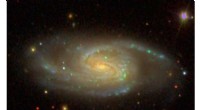
* Galaxies are moving apart: The universe is expanding, and as it does, galaxies are carried away from each other.
* Speed proportional to distance: The farther away a galaxy is, the faster it appears to be moving away from us. This means that a galaxy twice as far away will be moving twice as fast.
* Hubble Constant: This is a constant of proportionality that relates the distance to a galaxy and its recession velocity. It is denoted by the letter "H" and has a value of about 70 km/s/Mpc (kilometers per second per megaparsec). This means that for every megaparsec (3.26 million light-years) farther away a galaxy is, it is moving 70 km/s faster.
Implications of Hubble's Law:
* Evidence for the Big Bang: Hubble's Law is a key piece of evidence supporting the Big Bang theory, as it suggests that the universe began in a hot, dense state and has been expanding ever since.
* Age of the Universe: The Hubble Constant can be used to estimate the age of the universe, which is estimated to be around 13.8 billion years old.
* Understanding the Evolution of the Universe: Hubble's Law helps us understand how the distribution of galaxies has changed over time and provides insight into the forces that govern the universe.
Note: While Hubble's Law states that galaxies move away from us at a speed proportional to their distance, this does not mean that we are at the center of the universe. The expansion of the universe is happening everywhere, and every point in the universe can be considered a center of expansion.