1. Nuclear Fusion: Deep within the Sun's core, hydrogen atoms fuse together to form helium, releasing immense amounts of energy. This process is called nuclear fusion.
2. Photon Generation: The energy from fusion creates photons, which are tiny particles of light. These photons constantly collide with other particles within the Sun, bouncing around and taking a very long time to travel outwards.
3. Radiation Zone: The photons travel through the radiation zone, where they interact with the Sun's dense plasma. They are absorbed and re-emitted countless times, slowly making their way towards the surface.
4. Convection Zone: As photons reach the convection zone, they transfer energy to the Sun's plasma, causing it to heat up and rise. This hot plasma then cools and sinks, creating a cycle of convection that carries heat outwards.
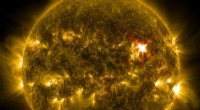
5. Photosphere: Finally, the photons reach the photosphere, the visible surface of the Sun. At this point, they escape into space as sunlight, carrying the Sun's energy away.
6. Electromagnetic Radiation: This sunlight travels through the vacuum of space as electromagnetic radiation. This radiation consists of various wavelengths, including visible light, infrared radiation (heat), and ultraviolet radiation.
7. Reaching Earth: A small fraction of this radiation reaches Earth, warming our planet and powering life.
Key Points:
* No Medium Needed: Unlike sound waves that require a medium like air or water to travel, electromagnetic radiation can travel through the vacuum of space.
* Speed of Light: Electromagnetic radiation, including light, travels at the speed of light (approximately 299,792,458 meters per second).
* Variety of Forms: The Sun emits electromagnetic radiation across a wide spectrum, from radio waves to gamma rays.
In essence, the Sun's energy is transferred through space using light and heat, carried by photons, traveling at the speed of light. It's a remarkable process that sustains life on Earth and illuminates the cosmos.