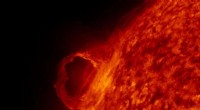
Here are the leading mechanisms proposed to explain the coronal heating:
1. Nanoflares:
* Concept: These are miniature solar flares, much smaller than the visible flares we see. They release energy in the form of waves and particles, heating the corona.
* Evidence: Some evidence exists for nanoflares, but they haven't been directly observed.
* Challenge: It's not clear if nanoflares are frequent enough to account for the observed coronal temperature.
2. Magnetic Reconnection:
* Concept: Magnetic field lines in the Sun's atmosphere intertwine and then break apart and reconnect. This process releases energy, heating the corona.
* Evidence: Magnetic reconnection is observed in larger flares and is a likely source of energy in the corona.
* Challenge: This process is not fully understood, and it may not be efficient enough to heat the entire corona.
3. Alfvén Waves:
* Concept: These are a type of wave that propagates along magnetic field lines. When these waves encounter the corona, they transfer energy to the coronal plasma, heating it.
* Evidence: Alfvén waves have been observed in the solar atmosphere.
* Challenge: It's not clear if Alfvén waves can carry enough energy to heat the corona efficiently.
4. Other Mechanisms:
* Some other proposed mechanisms include the dissipation of magnetohydrodynamic (MHD) waves, acoustic waves, and shock waves.
Current understanding:
* The coronal heating problem is still a major unsolved mystery in solar physics.
* It's likely that a combination of different mechanisms contribute to the coronal heating.
* The exact processes and their relative importance are still being researched.
Ongoing research:
* Scientists continue to study the Sun and its atmosphere using advanced telescopes and spacecraft.
* This research is crucial for understanding the dynamics of the Sun and its impact on Earth's environment.
It's important to remember that our understanding of the Sun is constantly evolving. As new data and theories emerge, we may gain a better understanding of the processes that heat the solar corona.