* Gravity's Pull: The Sun is much more massive than the Earth, and therefore has a much stronger gravitational pull. This pull acts as a constant force, attracting the Earth towards the Sun.
* Initial Momentum: When the solar system formed, the material that eventually became the Earth was in motion. This initial motion gave the Earth momentum.
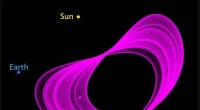
* Balance of Forces: The Earth's momentum keeps it moving in a straight line, while the Sun's gravity pulls it inward. This balance between the Earth's forward motion and the Sun's pull results in an orbit, a curved path around the Sun.
Think of it like a ball on a string:
* You swing the ball, giving it momentum to move forward.
* The string acts like the Sun's gravity, pulling the ball inward.
* This combination of forward motion and inward pull makes the ball travel in a circular path.
Key Points:
* The Earth's orbit is not perfectly circular, it's slightly elliptical.
* The Earth's speed is not constant throughout its orbit; it moves faster when it's closer to the Sun and slower when it's further away.
* Other planets in our solar system also orbit the Sun due to the same principles of gravity and momentum.