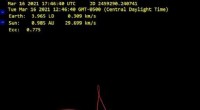
* Elliptical Shape: All planets follow elliptical paths around the Sun, not perfect circles. The Sun is located at one focus of the ellipse.
* Kepler's Laws: All planets obey Kepler's Laws of Planetary Motion:
* Law of Ellipses: As mentioned above, planets orbit the Sun in ellipses.
* Law of Equal Areas: A line connecting a planet to the Sun sweeps out equal areas in equal times. This means planets move faster when they are closer to the Sun and slower when they are farther away.
* Law of Periods: The square of a planet's orbital period (the time it takes to complete one orbit) is proportional to the cube of the semi-major axis of its orbit (the average distance from the Sun).
* Gravitational Force: All planets are held in their orbits by the Sun's gravitational force. The strength of this force depends on the mass of the Sun and the planet, and the distance between them.
* Conservation of Energy: The total energy (kinetic + potential) of a planet in orbit remains constant. This energy is exchanged between its speed and its distance from the Sun.
Key Differences:
While all planets share these similarities, there are some key differences between their orbits:
* Orbital Period: Each planet has a unique orbital period, ranging from 88 days for Mercury to 165 years for Neptune.
* Orbital Eccentricity: The shape of an ellipse is described by its eccentricity. Some planets have more eccentric orbits (more elliptical) than others, leading to greater variations in their distance from the Sun.
* Orbital Inclination: The plane of a planet's orbit is tilted relative to the plane of Earth's orbit (the ecliptic). This inclination varies for different planets.
In essence, all planets orbiting the Sun follow the same fundamental laws of physics, but their specific orbital characteristics are unique and determined by their initial conditions and the gravitational influence of the Sun.