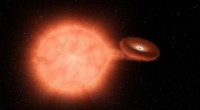
Planetary accretion is the process by which planets form from smaller particles in a protoplanetary disk. This disk, made of gas and dust, surrounds a young star.
Here's a simplified breakdown of the process:
1. Dust Grains: Tiny dust particles in the disk collide and stick together due to electrostatic forces.
2. Planetesimals: These growing dust clumps form larger, kilometer-sized objects called planetesimals.
3. Runaway Growth: Planetesimals continue to collide and accrete, gaining more mass. The larger they become, the stronger their gravity, leading to faster growth in a "runaway" process.
4. Protoplanets: Planetesimals eventually merge into protoplanets, bodies with significant gravitational pull.
5. Final Stages: Protoplanets continue to accrete material from the disk, sweep up remaining planetesimals, and even collide with each other. This process leads to the formation of the planets we see today.
Key Features:
* Gradual: Accretion is a slow, gradual process that can take millions or even billions of years.
* Collisional: The process relies on collisions between particles, planetesimals, and protoplanets.
* Gravitational: Gravity plays a crucial role in drawing particles together and holding them in place.
* Complex: Planetary accretion is a complex process with many factors influencing the final outcome, such as the composition of the protoplanetary disk, the size and distribution of planetesimals, and the presence of other planets.
Evidence:
* Meteorites: Studying the composition of meteorites provides insights into the building blocks of planets.
* Planetary Rings: The rings of Saturn are an example of a debris disk, similar to the one that existed around our Sun early in its formation.
* Exoplanets: Observing the formation of exoplanets around other stars gives us more data on how planets form.
Planetary accretion is a fascinating process that allows us to understand the origin and evolution of our own solar system and the countless other planets in the universe.