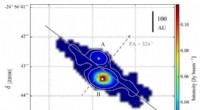
1. Rotation and Flattening: As the cloud collapsed, it began to spin faster due to the conservation of angular momentum. This rotation caused the cloud to flatten into a disk shape.
2. Accretion and Condensation: Within the disk, particles of dust and gas began to clump together due to electrostatic forces. These clumps grew larger through accretion, eventually forming planetesimals. As the disk cooled, heavier elements like iron and nickel condensed closer to the center, while lighter elements like hydrogen and helium remained further out.
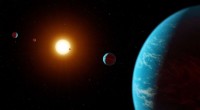
3. Planetary Formation: The planetesimals continued to collide and merge, eventually forming the planets we see today. The protosun, the center of the nebula, grew hotter and denser, eventually igniting nuclear fusion and becoming our Sun.
4. Formation of Satellites: Similar processes led to the formation of moons around the planets, as smaller planetesimals were captured by their gravitational pull.
So, in essence, the solar system formed from the gravitational collapse, rotation, and accretion of matter within a vast, rotating cloud of gas and dust.