Earth:
* Primarily composed of: Iron (32.1%), Oxygen (30.1%), Silicon (15.1%), Magnesium (13.9%), Sulfur (2.9%), Nickel (2.4%), Calcium (1.5%), and Aluminum (1.4%).
* Crust: Made up mostly of igneous rocks like granite and basalt.
* Mantle: Primarily composed of silicate minerals, with a rocky composition.
* Core: Consists of a solid inner core of iron and nickel, and a liquid outer core also primarily of iron and nickel.
Moon:
* Primarily composed of: Oxygen (43%), Silicon (20%), Iron (10%), Magnesium (9%), Calcium (5%), Aluminum (3%), Chromium (0.4%), Titanium (0.2%), and other elements.
* Crust: Mainly composed of anorthosite, a light-colored rock rich in calcium and aluminum.
* Mantle: Mostly composed of olivine and pyroxene, similar to Earth's mantle but with a lower density.
* Core: Smaller than Earth's and likely composed of iron with a small amount of sulfur.
Key Differences:
* Density: Earth is much denser than the Moon due to its iron-rich core.
* Water: Earth has a significant amount of water, both on the surface and underground, while the Moon has only traces of water ice in permanently shadowed craters.
* Atmosphere: Earth has a thick atmosphere, while the Moon has a very thin exosphere.
* Magnetic Field: Earth has a strong magnetic field, while the Moon's magnetic field is very weak.
* Volcanic Activity: Earth is volcanically active, while the Moon is largely inactive, although it shows signs of past volcanic activity.
* Tectonic Plates: Earth has active tectonic plates, while the Moon does not.
Origin of Differences:
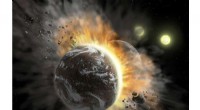
These differences are mainly attributed to the different ways the Earth and Moon formed. Earth formed from the accretion of dust and gas in the early solar system, while the Moon is thought to have formed from a giant impact between Earth and a Mars-sized object. This impact ejected a large amount of material into orbit, which eventually coalesced to form the Moon. This impact also significantly altered Earth's early composition and led to its differentiation into layers.
In summary, while both Earth and Moon share some similarities, their compositions are significantly different due to their distinct formation processes and evolutionary histories.