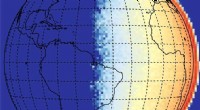
Ionosphere
* What it is: A layer of the atmosphere that is characterized by the presence of free ions and electrons. It's essentially an electrically charged layer.
* Where it is: Located roughly between 50 and 1,000 kilometers (31 to 621 miles) above Earth's surface. It overlaps with the thermosphere and the mesosphere.
* Importance: Crucial for radio communication, as it reflects radio waves back to Earth. It also plays a role in protecting us from harmful solar radiation.
Exosphere
* What it is: The outermost layer of Earth's atmosphere, where the atmosphere gradually fades into space. The air is extremely thin here, and molecules are so far apart that they rarely collide.
* Where it is: Begins at about 1000 kilometers (621 miles) above Earth's surface and extends outwards into space.
* Importance: The exosphere is the region where satellites orbit. It also plays a role in the escape of atmospheric gases into space.
Key differences:
* The ionosphere is characterized by the presence of ions and electrons, while the exosphere is defined by its extremely thin atmosphere.
* The ionosphere is crucial for radio communication, while the exosphere is primarily important for satellite orbits and the escape of atmospheric gases.
Remember, these layers are not distinct boundaries, but rather gradual transitions within Earth's atmosphere.