So, what's on the far side of the Moon? Here's what we know:
* More craters: The far side of the Moon has a higher density of craters than the near side. This is likely due to the near side being shielded from impacts by Earth's gravitational pull.
* Larger maria (seas): The far side has fewer maria, the dark plains of volcanic basalt. This means it has less smooth, flat areas.
* Thicker crust: The crust on the far side of the Moon is thicker than on the near side.
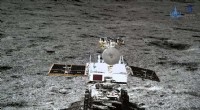
* Unique geological features: The far side has some fascinating geological features, including the South Pole-Aitken basin, one of the largest impact craters in the Solar System.
* Potential for future research: The far side of the Moon is considered a promising location for future scientific research, particularly for astronomy due to its lack of radio interference from Earth.
It's important to remember that the far side of the Moon receives just as much sunlight as the near side, it just faces away from us. The misconception of a "dark side" might have originated from the fact that we couldn't see it until spacecraft began orbiting the Moon and sending back images.