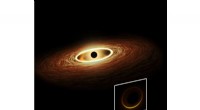
Here are some key features of primordial nebulae:
* Early Universe: They existed during the first few hundred million years after the Big Bang, when the universe was still very hot and dense.
* Composition: Primarily hydrogen and helium, with trace amounts of heavier elements produced during the Big Bang nucleosynthesis.
* Formation of Stars and Planets: These nebulae were the birthplace of the first stars and planets. Gravity caused these clouds to collapse, leading to the formation of stars, and the remaining material formed planets and other celestial objects.
* No Heavy Elements: They lacked the heavy elements that are common in modern nebulae, which are formed from the death of stars. These heavier elements are formed in the cores of stars through nuclear fusion and are then ejected into space when stars die.
* Low Density: Despite their vast size, primordial nebulae were very low in density, with most of the matter spread out over large distances.
While we cannot directly observe primordial nebulae today, they are crucial to understanding the formation of stars, planets, and galaxies in the early universe. Astronomers study the composition of stars and galaxies to infer the properties of the primordial nebulae from which they formed.
Here's a simple analogy: Imagine a giant cloud of cotton candy in space. That's a bit like a primordial nebula, but instead of sugar, it's mostly hydrogen and helium gas. This cloud collapses under its own gravity, forming clumps that eventually ignite as stars, leaving behind the leftover material that will form planets and other objects.