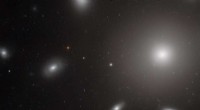
* Hubble's primary function isn't magnifying: It's more about capturing light from distant objects and resolving details we couldn't see from Earth. It does this by having a large primary mirror and being above the blurring effects of Earth's atmosphere.
* "Magnification" depends on the object: Hubble's "magnification" is relative to the distance of the object it's observing. The further away an object is, the more "magnified" it appears in the image.
* Focus, not magnification: Hubble's optics are designed to focus light from distant objects onto its detectors, creating sharp images.
Here's a better way to think about it:
Imagine Hubble is a very powerful camera with a telephoto lens. The lens gathers light from a far-off object and creates a detailed picture. The "magnification" is a result of the light-gathering ability of the lens, not a literal magnification like you'd find with a magnifying glass.
Instead of "magnification," you might hear terms like:
* Resolution: The ability to distinguish fine details in an image. Hubble's high resolution allows us to see objects that would be blurry or invisible from Earth.
* Angular resolution: The smallest angle between two points that the telescope can distinguish. A smaller angle means better resolution.
* Field of view: The area of the sky that the telescope can see at one time.
So, while Hubble doesn't have a fixed magnification, its powerful optics and location in space allow it to capture incredibly detailed images of distant objects, effectively "magnifying" the universe for us.