Low-Mass Stars (Sun-like and smaller)
* Fuel Consumption: They burn their hydrogen fuel slowly and steadily, lasting for billions of years.
* Evolution:
* Red Giant: As hydrogen fuel runs out, the core contracts and heats up, causing the outer layers to expand and cool, forming a red giant.
* Helium Fusion: Eventually, the core gets hot enough to fuse helium into carbon and oxygen.
* Planetary Nebula: The outer layers are expelled as a planetary nebula, a beautiful shell of glowing gas.
* White Dwarf: The remaining core, composed mostly of carbon and oxygen, cools and becomes a dense white dwarf.
High-Mass Stars (8 times the Sun's mass or more)
* Fuel Consumption: They burn their fuel rapidly and intensely due to their high gravity and core temperatures.
* Evolution:
* Supergiant: They evolve through a series of giant phases, becoming red supergiants as they exhaust their hydrogen fuel.
* Fusion of Heavier Elements: Due to their extreme temperatures and pressures, they can fuse heavier elements like carbon, oxygen, silicon, and even iron.
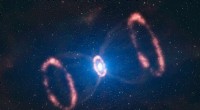
* Supernova: Iron is the heaviest element they can fuse, and its fusion doesn't release energy. This causes the core to collapse violently, leading to a supernova explosion, a cosmic explosion brighter than a whole galaxy.
* Remnant: The supernova leaves behind either:
* Neutron Star: If the core is between 1.4 and 3 solar masses, it collapses into a neutron star, an incredibly dense object packed with neutrons.
* Black Hole: If the core is more massive than 3 solar masses, it collapses into a black hole, a region of spacetime where gravity is so strong that nothing, not even light, can escape.
Summary of Differences:
* Fuel Burning Rate: High-mass stars burn their fuel much faster than low-mass stars.
* Core Temperature and Pressure: High-mass stars have much higher core temperatures and pressures, allowing them to fuse heavier elements.
* Final Stage: Low-mass stars end as white dwarfs, while high-mass stars end as neutron stars or black holes.
The differences in their end-of-life paths are ultimately driven by their initial mass, which dictates their internal structure, fuel burning rate, and the potential for heavier element fusion. These differences have significant implications for the evolution of galaxies and the formation of new stars and planets.