1. Initial Dust and Gas Cloud:
* The process starts with a vast cloud of gas and dust in space. This cloud is primarily made of hydrogen and helium, along with small amounts of heavier elements.
* Tiny particles within this cloud are constantly moving and colliding.
2. Gravity's Pull:
* Over time, the cloud begins to collapse due to its own gravity. As the cloud shrinks, it spins faster due to the conservation of angular momentum.
* Gravity pulls more matter towards the center of the cloud, creating a dense core. This core eventually becomes the star.
3. Planetesimals:
* Within the swirling disk of gas and dust around the young star, smaller particles begin to clump together through collisions. This process is aided by electrostatic forces.
* These small clumps grow larger and larger, forming planetesimals, which are kilometer-sized objects.
4. Accretion:
* Gravity pulls more planetesimals and dust towards each other, causing them to collide and merge.
* Larger planetesimals have stronger gravitational pulls, making them more likely to attract and capture even more material.
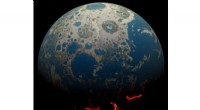
* This continuous process of collisions and merging leads to the formation of planets.
5. Differentiation:
* As planets grow, their internal temperatures increase due to the heat generated by collisions and radioactive decay.
* This heat causes the heavier elements (like iron and nickel) to sink towards the planet's core, while lighter elements (like silicates) rise to the surface. This process is called differentiation.
6. Clearing the Neighborhood:
* As planets grow larger, their gravitational influence becomes strong enough to clear out their orbital paths of smaller objects.
* This process is called "clearing the neighborhood" and is a key characteristic defining a planet as distinct from smaller objects like dwarf planets.
In summary: Gravity is the fundamental force responsible for attracting and accumulating matter, driving the formation of planets from the initial dust and gas cloud to the final, differentiated bodies we see today.