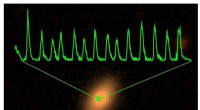
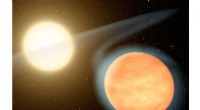
1. Pulsars: These are rapidly rotating neutron stars that emit beams of electromagnetic radiation. Due to their rotation, these beams sweep across space like a lighthouse beam. Scientists can use pulsars to study the structure of the Milky Way and to detect gravitational waves.
2. Quasars: These are extremely luminous objects powered by supermassive black holes at the centers of galaxies. They emit jets of matter and radiation that can be seen across the universe.
3. Supernovae: These are powerful explosions that occur when massive stars reach the end of their lives. They briefly outshine entire galaxies and leave behind neutron stars or black holes.
4. Active Galactic Nuclei (AGN): These are galaxies with supermassive black holes at their centers that are actively accreting matter. They emit vast amounts of radiation, making them some of the brightest objects in the universe.
5. Beacons: While not a natural object, humans have sent out "beacons" into space. These are signals transmitted from Earth with the hope of being detected by extraterrestrial life.
So, while there's no official "lighthouse of space," these objects all act as bright and powerful sources of light and radiation in the universe, much like lighthouses on Earth guide ships at sea.