1. Standard Candle:
- White dwarfs of a specific type (like those in cataclysmic variable stars) have a well-defined, intrinsic luminosity (absolute brightness).
- This means they emit a known amount of light.
2. Observable Properties:
- Their luminosity is related to their temperature, which can be measured from their color and spectral features.
- These properties are relatively stable over time.
3. Distance Calculation:
- By comparing the observed apparent brightness (how bright they appear to us) with their intrinsic luminosity, we can use the inverse square law of light to determine the distance to the white dwarf.
4. Types of White Dwarf Distance Indicators:
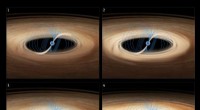
- Cataclysmic Variables (CVs): These binary systems contain a white dwarf accreting matter from a companion star. Their brightness variations are predictable and tied to the white dwarf's luminosity.
- White Dwarf Cooling Sequence: White dwarfs cool down over time, and their temperature is related to their age. This allows us to estimate their age and, in turn, their intrinsic luminosity.
- Spectroscopic Parallax: This technique analyzes the spectra of white dwarfs to infer their surface gravity, which is related to their mass. This allows for a distance estimation based on their absolute magnitude.
5. Advantages Over Other Indicators:
- White dwarfs are less affected by interstellar dust and gas obscuration compared to other distance indicators like Cepheid variables.
- They are relatively stable over long periods, making them useful for measuring distances across vast distances.
Limitations:
- White dwarfs are fainter than other distance indicators, making them harder to observe.
- There can be uncertainties in determining their intrinsic luminosity and age, leading to errors in distance measurements.
Overall, white dwarfs provide a powerful tool for measuring cosmic distances, helping astronomers map the universe and understand its structure. They play a crucial role in understanding the scale and evolution of the cosmos.