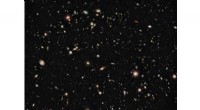
Gravitational lensing is a phenomenon where the gravity of a massive object, like a galaxy or a cluster of galaxies, bends the path of light from distant objects behind it. This bending acts like a lens, magnifying and distorting the image of the background object.
Here's how it relates to dark matter:
* Unexpected Lensing: Astronomers observed that the amount of lensing happening was much stronger than what could be explained by the visible matter alone. This indicated the presence of a substantial amount of unseen matter, dubbed "dark matter".
* Missing Mass: The rotation speeds of galaxies and the movements of galaxies within clusters also pointed towards the presence of more matter than what we can see. This "missing mass" was consistent with the amount of dark matter inferred from gravitational lensing.
* Dark Matter Maps: By analyzing the lensing effects on distant galaxies, astronomers can map out the distribution of dark matter in the universe. This reveals that dark matter is not uniformly spread but rather concentrated in halos around galaxies and clusters.
Implications for our understanding of the universe:
* Dominant Constituent: Dark matter, revealed through lensing and other observations, is estimated to account for about 85% of the universe's matter. This makes it a crucial factor in understanding the formation and evolution of galaxies, clusters, and the universe as a whole.
* Cosmic Structure: The distribution of dark matter, mapped by gravitational lensing, shapes the large-scale structure of the universe. It explains how galaxies cluster together and how the cosmic web forms.
* Cosmological Models: Gravitational lensing plays a vital role in refining our cosmological models, which describe the evolution of the universe. It helps us understand the expansion rate, the age, and the composition of the universe.
* Beyond Standard Model: Dark matter's mysterious nature, its lack of interaction with light, and its impact on gravitational lensing strongly suggests that it is something entirely different from the particles we know from the Standard Model of particle physics.
In summary: Gravitational lensing serves as a powerful tool for detecting and studying dark matter, revealing its abundance, distribution, and impact on the universe. This relationship has significantly enhanced our understanding of the cosmos, leading to new questions and further research into the nature of dark matter and its role in the grand scheme of the universe.