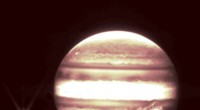
* They are both made up primarily of hydrogen and helium. This makes them both gas giants.
* They both have strong gravitational pulls. Jupiter's gravitational pull is so strong it has been nicknamed the "vacuum cleaner" of the solar system, attracting many asteroids and comets. The Sun's gravitational pull keeps all the planets in orbit around it.
* They both emit heat. The Sun, of course, generates heat through nuclear fusion. Jupiter, however, emits more heat than it receives from the Sun, due to internal processes like gravitational contraction.
However, it's important to note that they are also very different:
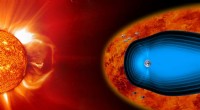
* The Sun is a star, while Jupiter is a planet. This means the Sun generates its own light and heat, while Jupiter only reflects the Sun's light.
* The Sun is much larger and more massive than Jupiter. The Sun contains over 99% of the mass in our solar system.
* The Sun undergoes nuclear fusion, while Jupiter does not. This is a key difference that makes the Sun a star and Jupiter a planet.
So, while they share some similarities in composition and gravitational pull, their fundamental nature and role in the solar system are vastly different.