1. Gravity: The Sun's immense mass exerts a strong gravitational pull on the planets. This pull is constantly trying to draw the planets closer to the Sun.
2. Inertia: Planets are also moving, carrying their own momentum. This momentum wants to keep them moving in a straight line.
The Balance: These two forces are in constant opposition. The Sun's gravity wants to pull the planets in, while the planets' inertia wants to keep them moving straight out. The result of this balance is a circular (or elliptical) orbit.
Imagine a ball on a string:
* Gravity: The string represents the Sun's gravity, pulling the ball towards the center.
* Inertia: The ball's movement represents the planet's inertia, wanting to fly off in a straight line.
The tension in the string (gravity) keeps the ball moving in a circle around your hand (the Sun). If you let go of the string, the ball would fly off in a straight line.
Why not a straight line?
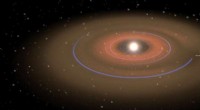
If a planet were to move in a straight line, it would either escape the Sun's gravity entirely or crash into it. The curved path of the orbit is the only way for the planet to stay in a stable, balanced position around the Sun.
Elliptical Orbits:
Most planets don't have perfectly circular orbits. They have slightly elliptical orbits, meaning they are slightly oval-shaped. This is because their speed changes throughout their orbit. They are faster when they are closer to the Sun and slower when they are further away.
The combination of gravity, inertia, and the planet's speed creates the beautiful, complex dance of the planets around the Sun.