From Earth:
* Telescopes: Ground-based telescopes can observe Mercury, but it's tricky due to its proximity to the Sun. Scientists use specialized telescopes that can block out the Sun's glare, allowing them to study its surface features, rotation, and atmosphere.
* Radar: By bouncing radio waves off Mercury's surface, scientists can create detailed maps of its topography and measure its rotation rate.
* Spectroscopy: Studying the light reflected from Mercury allows scientists to identify the elements and minerals present on its surface.
From Space:
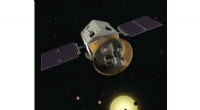
* Spacecraft missions: The most detailed information about Mercury comes from spacecraft missions.
* Mariner 10 (1974-1975): The first spacecraft to fly by Mercury, providing the first close-up images and data about its surface.
* MESSENGER (2011-2015): Orbited Mercury for four years, collecting vast amounts of data about its geology, composition, magnetic field, and atmosphere.
* BepiColombo (2018-present): A joint mission by the European Space Agency and the Japan Aerospace Exploration Agency, currently in orbit around Mercury. It is providing even more detailed information about the planet, including its internal structure and history.
Key areas of study:
* Surface geology: Studying craters, volcanic plains, and other surface features to understand the history of Mercury's formation and evolution.
* Composition: Determining the chemical makeup of Mercury's surface and interior to understand its origins and relationship to other planets.
* Magnetic field: Investigating Mercury's surprisingly strong magnetic field for clues about its internal structure and dynamics.
* Atmosphere: Studying Mercury's extremely thin exosphere to understand how it interacts with the solar wind.
* Internal structure: Using data from gravity measurements and seismic waves to study the composition and structure of Mercury's core, mantle, and crust.
Challenges:
* Proximity to the Sun: The intense solar radiation and heat pose challenges for spacecraft, requiring special shielding and cooling systems.
* Small size: Mercury's small size and weak gravity make it difficult to achieve stable orbits and maintain spacecraft around it.
* Limited sunlight: Mercury's small size means it receives less sunlight than other planets, making it difficult for spacecraft to generate enough power.
Despite these challenges, scientists continue to push the boundaries of our knowledge about Mercury, using advanced technology and innovative techniques to unlock its secrets.