1. Visual Observation:
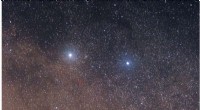
* Direct Imaging: If the stars are sufficiently far apart, they can be visually resolved using telescopes. This method directly observes the two stars orbiting each other.
2. Astrometry:
* Wobbling: Stars in a binary system exert gravitational pull on each other, causing them to wobble slightly. By precisely measuring a star's position over time, astronomers can detect this wobble and infer the presence of a companion.
3. Spectroscopy:
* Doppler Shift: The light emitted by a star shifts towards the blue end of the spectrum when it is moving towards us, and towards the red end when it is moving away. By analyzing the spectral lines of a star, astronomers can detect periodic shifts due to the orbital motion of the star in a binary system. This is known as the radial velocity method.
4. Photometry:
* Eclipsing Binaries: In some cases, the stars in a binary system are oriented so that they eclipse each other from our viewpoint. This causes periodic dips in the combined brightness of the system. By analyzing the timing and depth of these dips, astronomers can deduce the sizes, masses, and orbital parameters of the stars.
5. Other Methods:
* Gravitational Lensing: If a binary system passes in front of a distant star, its gravity can bend the light from the background star, creating a distorted image. The patterns of these distortions can reveal the presence and properties of the binary system.
* Radio Emission: Some binary systems emit strong radio waves, which can be detected with radio telescopes. These emissions are often associated with the interaction between the stars and their surrounding environment.
Determining the Type of Binary:
The different methods can also help classify binary systems into different types:
* Visual Binaries: These are the most straightforward to detect, with both stars visible through a telescope.
* Spectroscopic Binaries: These are identified through spectral analysis, showing periodic Doppler shifts.
* Eclipsing Binaries: These are identified through the periodic dimming of light caused by the eclipsing of the stars.
* Astrometric Binaries: These are identified through the wobble of one star caused by the gravitational pull of its companion.
The choice of method for detecting a binary system depends on factors such as the separation of the stars, their brightness, and the nature of the system itself. Combining multiple methods often provides the most complete picture of a binary star system.