Here's how it works:
* Gravity: Every object with mass has gravity, which pulls everything towards its center. For a planet, this means that everything on its surface, including rocks, water, and even the atmosphere, is pulled inwards.
* Internal Heat: Planets are formed from the accretion of smaller objects. This process generates a lot of heat, and the planet's core remains hot for a long time. This heat makes the planet's interior soft and deformable.
The Process:
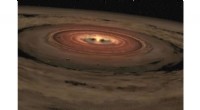
1. Early Formation: When a planet is forming, it starts as a collection of smaller objects. The gravitational pull of these objects attracts more material, leading to a growing mass.
2. Gravity's Influence: As the planet grows, its gravity becomes stronger. This pulls the material in towards the center, forcing the planet to become more compact.
3. Heat and Deformability: The internal heat makes the planet's interior more fluid, allowing the gravity to pull the planet into a more spherical shape.
4. Equilibrium: Over time, the planet reaches a point where the force of gravity pulling inwards is balanced by the internal pressure pushing outwards. This equilibrium results in a near-perfect sphere.
Not perfectly round:
While planets are generally round, they are not perfectly spherical. Factors like rotation and internal structure can cause slight deviations from a perfect sphere. For example, the Earth is slightly flattened at the poles and bulging at the equator due to its rotation.
In conclusion: The round shape of planets is a result of the balance between gravity pulling everything inwards and the planet's internal heat and pressure pushing outwards. This leads to a near-spherical shape, the most stable configuration for a large object with significant gravity.