1. Birth (Nebula to Protostar):
* Start with a Nebula: Stars are born within giant clouds of gas and dust called nebulae.
* Gravity takes hold: Over time, gravity pulls material within a nebula together, forming a denser, hotter core.
* Protostar: This dense core becomes a protostar, a hot, glowing ball of gas, still gathering material.
2. Main Sequence:
* Nuclear Fusion Begins: The protostar's core becomes so hot and dense that nuclear fusion starts. Hydrogen atoms fuse to form helium, releasing enormous amounts of energy, creating light and heat.
* Stable Stage: This stage is called the main sequence, and it's the longest stage of a star's life. The star remains relatively stable, burning its hydrogen fuel.
* Our Sun: Our own Sun is currently in its main sequence stage.
3. Giant and Supergiant Stages:
* Hydrogen Depletion: Eventually, the star runs out of hydrogen fuel in its core.
* Core Contraction and Heating: The core contracts and heats up, igniting fusion of heavier elements like helium.
* Expansion: The outer layers of the star expand dramatically, turning it into a red giant (for smaller stars) or a red supergiant (for larger stars).
* Variable Stars: Stars in these stages often become unstable and pulsate, changing in brightness.
4. End of Life (Depending on Mass):
* Low-Mass Stars (like our Sun):
* Planetary Nebula: The outer layers of the star are ejected, forming a beautiful planetary nebula.
* White Dwarf: The core collapses into a dense, hot, white dwarf, slowly cooling over billions of years.
* Medium-Mass Stars:
* Supernova: The star explodes in a spectacular supernova, creating heavier elements and releasing enormous amounts of energy.
* Neutron Star: The core collapses into a neutron star, a tiny, extremely dense object.
* High-Mass Stars:
* Supernova: The star explodes in a supernova, even more powerful than those of medium-mass stars.
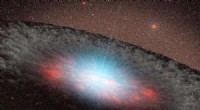
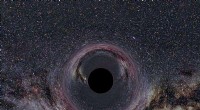
* Black Hole: The core collapses into a black hole, an object with such intense gravity that nothing, not even light, can escape.
Important Notes:
* Time Scales: The lifespans of stars vary drastically depending on their mass. Larger stars burn hotter and faster, having shorter lifespans than smaller stars.
* Evolution is Continuous: The transition between these stages is a continuous process, with no sharp dividing lines.
* Complexities: There are many other complexities involved in stellar evolution, including the role of rotation, magnetic fields, and interactions with other stars.
This explanation is just a basic overview. Stellar evolution is a fascinating and complex field of study in astronomy.