Here's a breakdown:
* Wien's Displacement Law: This law states that the peak wavelength of radiation emitted by a blackbody is inversely proportional to its temperature. In simpler terms, hotter objects emit light at shorter wavelengths, appearing bluer, while cooler objects emit light at longer wavelengths, appearing redder.
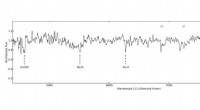
* Stellar Spectra: Stars emit light across the entire electromagnetic spectrum, but their spectra (the distribution of light at different wavelengths) have distinct peaks. Astronomers analyze these spectra to determine the peak wavelength, which directly corresponds to the star's temperature.
* Spectral Classification: Stars are classified according to their spectral types, which are denoted by letters from O (hottest) to M (coolest). This classification system is based on the presence or absence of certain spectral lines, which are related to the temperature of the star's atmosphere.
Other methods used to estimate star temperatures:
* Luminosity: A star's luminosity (the total amount of energy it emits per unit time) is related to its temperature. Astronomers can estimate a star's temperature using its luminosity and other properties, such as its size and distance.
* Parallax: Measuring the distance to a star using parallax allows astronomers to calculate its absolute magnitude (its intrinsic brightness). This information, along with the star's apparent magnitude (how bright it appears from Earth), can be used to estimate its temperature.
While color is the primary indicator, these other methods provide valuable information and help refine our understanding of a star's temperature.