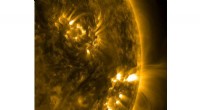
1. Gravity: The Sun is incredibly massive, containing 99.86% of the total mass of the solar system. This immense mass creates a powerful gravitational pull that draws all the other objects towards it, including the planets.
2. Initial Conditions: When the solar system formed from a giant cloud of gas and dust, the materials were swirling around a central point. This rotation resulted in the formation of a proto-sun at the center, and the remaining material clumped together to form planets. The planets inherited the initial rotational motion from the cloud.
3. Angular Momentum Conservation: The planets also maintain their orbital motion due to the principle of conservation of angular momentum. This principle states that the total angular momentum of a system remains constant. As the planets revolve around the Sun, they maintain their angular momentum, keeping them in their orbits.
4. Centrifugal Force: As planets orbit the Sun, they experience a centrifugal force that pushes them outwards. This force is balanced by the inward pull of the Sun's gravity, resulting in a stable orbit.
5. No External Interference: The planets are in a relatively isolated environment, with minimal external influences that could disrupt their orbits. This isolation allows them to maintain their stable paths around the Sun.
In summary:
* The Sun's immense gravity acts as the primary force holding the planets in their orbits.
* The planets inherited their initial motion from the swirling cloud of gas and dust that formed the solar system.
* Conservation of angular momentum and the balance between centrifugal force and gravity contribute to the stability of their orbits.
* The absence of significant external influences allows the planets to continue their revolutions around the Sun.