Here's why:
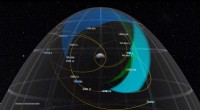
* Orbiting a planet allows for repeated observations: Orbiters circle the planet, repeatedly passing over different areas. This allows them to gather data from multiple angles and perspectives, leading to a comprehensive map.
* Variety of instruments: Orbiters are equipped with a wide range of instruments, including cameras, spectrometers, radar systems, and more. These instruments can capture images, analyze the composition of the surface, measure elevation, and even detect subsurface features.
* Global coverage: By orbiting the planet, missions can cover a much larger area than a lander or rover. This allows for the creation of global maps, showing the planet's entire surface.
Some examples of famous orbiter missions that have produced detailed maps include:
* Mars Reconnaissance Orbiter (MRO): This NASA mission has been mapping Mars since 2006 and has produced incredibly detailed images of its surface.
* Cassini-Huygens: This joint NASA/ESA mission explored Saturn and its moons, providing us with stunning images and data about the Saturnian system.
* Lunar Reconnaissance Orbiter (LRO): This NASA mission has created detailed maps of the Moon, including its surface features, composition, and gravity field.
While landers and rovers can provide valuable data about specific locations, it is the orbiters that provide the necessary global perspective and wide-ranging data to create detailed maps of planets.