Here's why:
* Eccentricity describes the shape of an orbit. A perfectly circular orbit has an eccentricity of 0, while a highly elongated elliptical orbit has an eccentricity close to 1.
* Distance from the Sun is determined by the semi-major axis of the orbit. This is the average distance between the planet and the Sun.
Here's an example:
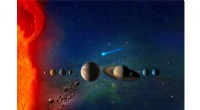
* Mercury has the most eccentric orbit of all the planets in our solar system. However, it is also the closest planet to the Sun.
* Mars has a less eccentric orbit than Mercury but is much farther from the Sun.
Therefore, a planet's distance from the Sun is determined by its semi-major axis, and its orbital shape is determined by its eccentricity. These two factors are independent of each other.
However, it's important to note that:
* Eccentricity influences a planet's distance from the Sun at different points in its orbit. A highly eccentric orbit means a planet will experience a significant variation in its distance from the Sun throughout its orbital path.
* Orbital eccentricity can be influenced by gravitational interactions with other planets. For example, Jupiter's massive gravitational pull can affect the eccentricity of other planets in the solar system.
Overall, while there is no direct relationship between eccentricity and distance from the Sun, they are both important factors in understanding a planet's orbital behavior.