Electromagnetic Radiation:
* Infrared Radiation: Stars emit a significant amount of infrared radiation, especially cooler stars like red giants. This is heat radiation that we feel as warmth.
* Ultraviolet Radiation: Hotter stars like blue giants emit a lot of ultraviolet radiation. This is energetic radiation that can cause sunburns and damage DNA.
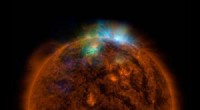
* X-rays: Some stars, particularly active ones, emit X-rays. These are even more energetic than UV radiation and can penetrate deep into matter.
* Gamma Rays: The most energetic form of electromagnetic radiation, gamma rays are produced by powerful events like supernova explosions and the decay of radioactive elements in stars.
Particle Radiation:
* Solar Wind: Stars, including our Sun, constantly release a stream of charged particles (mostly protons and electrons) called the solar wind. This wind can interact with Earth's magnetic field, causing auroras.
* Cosmic Rays: High-energy particles from outside the solar system that can reach Earth. These include protons, electrons, and heavier nuclei, and they are thought to originate from supernovae and other energetic events.
Other Forms:
* Gravitational Waves: Massive stars can emit gravitational waves as they collapse into black holes or neutron stars. These waves are ripples in spacetime, and they are very difficult to detect.
* Neutrinos: Stars produce neutrinos, which are tiny, neutral particles that interact very weakly with matter. While they are very numerous, they are also very difficult to detect.
The specific types and intensity of radiation emitted by a star depend on its size, temperature, age, and other properties.