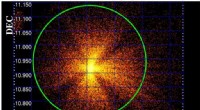
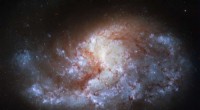
1. Starburst Galaxy: M82 is a starburst galaxy, meaning it is experiencing an unusually high rate of star formation. This is driven by a powerful galactic wind emanating from its core, which is caused by gravitational interactions with its neighbor, the spiral galaxy M81. This wind compresses clouds of gas, triggering the birth of new stars at a rate several hundred times higher than in our own Milky Way.
2. Superwind: The starburst activity in M82 is so intense that it generates a massive outflow of gas and dust called a superwind. This wind, traveling at hundreds of kilometers per second, is visible in ultraviolet and X-ray wavelengths and is pushing material out of the galaxy's core into the surrounding intergalactic medium.
3. High Mass Star Formation: M82 is a prime location for the formation of massive stars. These stars, much larger than our Sun, have short but brilliant lives, eventually exploding as supernovae.
4. Strong Infrared Emission: The intense starburst activity heats up the dust and gas in M82, causing it to emit strongly in infrared wavelengths. This makes M82 a bright and well-studied object in the infrared sky.
5. Unusual Structure: Unlike most spiral galaxies, M82 has a very distinctive elongated shape, resembling a cigar. This shape is attributed to the gravitational interactions with M81, which have distorted M82's structure.
6. Young Supernova Remnants: M82's high star formation rate produces a large number of supernova remnants. These expanding shells of debris from exploded stars are visible in various wavelengths, including radio and X-ray.
7. Potential for Studying Galactic Evolution: Studying M82 helps us understand the processes of starburst activity, galactic winds, and how galaxies evolve. Its intense activity provides a unique laboratory to study the interplay between star formation, gas dynamics, and galactic structure.
In summary, M82 is a unique and fascinating galaxy with its extreme starburst activity, powerful superwind, high mass star formation, unusual structure, and vibrant supernova remnants. It provides a window into the dynamic processes of star formation and galaxy evolution.