1. Unimpeded View: Being above Earth's atmosphere eliminates the blurring and distortion caused by atmospheric turbulence. This results in significantly sharper and clearer images.
2. Access to the Full Electromagnetic Spectrum: Earth's atmosphere blocks much of the electromagnetic spectrum, particularly in the infrared and ultraviolet regions. Hubble, being in space, can observe these wavelengths with no atmospheric interference, providing a more complete view of celestial objects.
3. Longer Observations: Hubble can observe celestial objects for extended periods without interruption from weather or daylight. This enables scientists to study faint objects and phenomena that require prolonged observation.
4. Stability and Precision: Hubble's stable platform in space allows for extremely precise pointing and tracking of celestial objects, resulting in highly detailed images and measurements.
5. Upgradability: Hubble's modular design has allowed for multiple servicing missions, enabling scientists to replace or upgrade instruments and keep the telescope at the forefront of astronomical research.
Specific advantages:
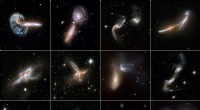
* High resolution: Hubble's advanced optics produce images with incredible detail, revealing features of distant galaxies and nebulae that would be impossible to see from Earth.
* Wide field of view: Hubble's instruments allow for capturing large areas of the sky, enabling surveys of distant galaxies and star clusters.
* Deep-sky observations: Hubble's sensitive instruments can detect extremely faint objects, including distant galaxies and quasars, providing insights into the early universe.
Overall:
Hubble's unique position in space and advanced technology have made it one of the most productive scientific instruments in history. Its contributions to our understanding of the universe are unparalleled, and its legacy will continue to inspire generations of scientists.