1. Stars with less than 8 times the mass of the Sun:
* White Dwarf: The core of the star collapses under its own gravity, becoming extremely dense and hot. It stops collapsing due to electron degeneracy pressure, a quantum mechanical force that prevents electrons from occupying the same energy level. White dwarfs are incredibly dense, packing the mass of the Sun into a sphere the size of Earth. They slowly cool over billions of years, eventually fading into black dwarfs.
2. Stars with 8 to 25 times the mass of the Sun:
* Neutron Star: The core collapses even further than in a white dwarf, forcing protons and electrons to combine into neutrons. The resulting neutron star is incredibly dense, with a teaspoon of its material weighing billions of tons. It is held up by neutron degeneracy pressure, a similar force to electron degeneracy pressure. Neutron stars are incredibly hot and emit powerful electromagnetic radiation, often observed as pulsars.
3. Stars with more than 25 times the mass of the Sun:
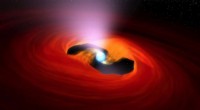
* Black Hole: In the most massive stars, gravity overcomes all other forces. The core collapses endlessly, creating an infinitely dense point known as a singularity. The region around the singularity is a black hole, where gravity is so strong that not even light can escape. Black holes warp spacetime and have a profound impact on their surroundings.
Beyond the Basics:
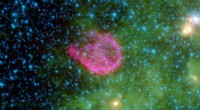
* Supernova: Before a star collapses into a white dwarf, neutron star, or black hole, it often undergoes a supernova explosion. This is a massive explosion that releases an enormous amount of energy, scattering the star's outer layers into space.
* Other Exotic Objects: There are theoretical possibilities for even more exotic objects formed from stellar collapse, such as quark stars or strange stars. However, these have not been definitively observed.
In Summary:
The collapse of a star leads to a variety of intriguing and powerful objects, all determined by the star's initial mass. The final product is a testament to the incredible forces at play within the cosmos.