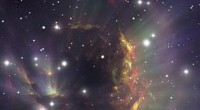
Planetary nebulae are not related to planets in any way, despite their name. They are actually the beautiful, glowing shells of gas and dust expelled from the outer layers of a dying star, specifically a red giant.
Here's a breakdown of the process:
1. Red Giant Stage: As a star like our Sun exhausts its hydrogen fuel, it begins to fuse heavier elements in its core, causing it to expand into a red giant. This expansion pushes the outer layers of the star outwards, forming a giant, cool shell of gas.
2. Ejection of the Outer Layers: Eventually, the core of the star becomes extremely hot and dense. This intense heat causes the outer layers to be violently expelled into space, forming a nebula. The ejected gas is often enriched with heavy elements like carbon and oxygen, which were created during the star's lifetime.
3. Ionization and Emission: The hot, dense core of the dying star, now a white dwarf, emits intense ultraviolet radiation. This radiation ionizes the ejected gas, causing it to glow brightly. The specific color and shape of the nebula depend on the composition of the gas and the strength of the ultraviolet radiation.
4. Dispersion and Fade: Over time, the expanding nebula will gradually disperse and cool, eventually becoming invisible. However, the white dwarf remnant of the star will continue to exist for billions of years.
Why are they called planetary nebulae?
The name "planetary nebula" was given by William Herschel in the late 18th century because he observed them through his telescope and they appeared as round, disc-like objects, resembling planets.
In Summary:
Planetary nebulae are the beautiful, glowing shells of gas ejected from dying stars. They are a dramatic and spectacular display of the final stages of a star's life, and they provide valuable insights into the evolution of stars and the chemical composition of the universe.