Here's why:
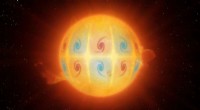
* Giant Stars: These stars are nearing the end of their lives, having exhausted the hydrogen fuel in their cores. They swell to enormous sizes and become unstable.
* Core Collapse: The core of a giant star starts to collapse under its own gravity. This collapse triggers a chain reaction of nuclear fusion, releasing tremendous energy.
* Explosion: The energy released from the core collapse causes the star to explode in a brilliant, incredibly bright supernova.
Types of Supernovae:
* Type II Supernova: These occur in massive stars (at least 8 times the mass of the Sun).
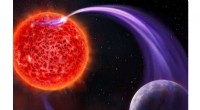
* Type Ia Supernova: These occur in binary star systems where a white dwarf star pulls matter from a companion star, leading to a runaway fusion reaction.
Supernovae are incredibly powerful events, leaving behind either a neutron star or a black hole, and scattering heavy elements into space. They are responsible for enriching the universe with the elements necessary for life.