For stars like our Sun:
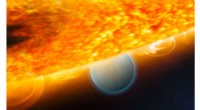
* Expansion and cooling: As a star exhausts its hydrogen fuel, it starts to fuse heavier elements like helium in its core. This process generates less energy and causes the star to expand significantly, becoming a red giant. The star's surface temperature also cools, resulting in a reddish hue.
* Increased luminosity: Despite cooling, the red giant phase is marked by a significant increase in the star's overall luminosity due to its larger surface area.
* Mass loss: The star becomes unstable and starts shedding its outer layers, forming a planetary nebula.
* Formation of a white dwarf: Eventually, the star's core, now composed mainly of carbon and oxygen, becomes a dense and hot white dwarf. This remnant slowly cools over billions of years, eventually becoming a black dwarf.
For massive stars:
* Supergiant phase: Massive stars evolve much faster than smaller ones and experience a much more dramatic death. They enter a supergiant phase, becoming incredibly luminous and expanding to enormous sizes.
* Nuclear fusion of heavier elements: Massive stars continue to fuse heavier elements in their core, eventually reaching iron. Iron fusion does not release energy but absorbs it, leading to a catastrophic collapse.
* Supernova explosion: The core collapse triggers a violent supernova explosion. This event releases an immense amount of energy and light, often outshining entire galaxies for a brief time.
* Formation of a neutron star or black hole: The supernova explosion leaves behind either a dense neutron star or, if the star was massive enough, a black hole.
General Indicators:
* Decreasing surface temperature: This is a common sign of a star's aging, leading to a change in its color towards redder hues.
* Changes in spectral lines: Analyzing the light emitted by a star reveals its chemical composition. Changes in the abundance of certain elements can indicate the star's evolutionary stage.
* Increased variability: As a star ages, it becomes less stable and exhibits more fluctuations in its brightness, pulsation, and other properties.
It's important to note that these changes occur over extremely long periods, often millions or billions of years. We can only observe these processes by studying stars at different stages of their evolution.