Initial Mass:
* Low-mass stars (less than 0.8 solar masses): These stars live for a very long time, slowly burning their hydrogen fuel. They become red giants and eventually end up as white dwarfs, which are relatively small and dense.
* Intermediate-mass stars (0.8 to 8 solar masses): These stars spend a shorter time on the main sequence but still evolve to become red giants. They then go through a series of stages, potentially experiencing planetary nebulae before ending as white dwarfs.
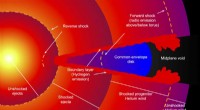
* High-mass stars (greater than 8 solar masses): These stars live fast and die young. They burn through their fuel rapidly, eventually becoming red supergiants. Their deaths are spectacular, resulting in supernova explosions. The remnants of the supernova can be neutron stars or black holes, depending on the initial mass.
Final Size:
* White Dwarfs: These are the remnants of low-mass and intermediate-mass stars. They are extremely dense, roughly the size of the Earth.
* Neutron Stars: These are formed from the cores of massive stars after a supernova. They are incredibly dense, packing a mass greater than our sun into a sphere only about 20 kilometers across.
* Black Holes: The most massive stars collapse into black holes after a supernova. These objects are so dense that their gravitational pull is so strong that not even light can escape. Their size is defined by their Schwarzschild radius, which depends on their mass.
In summary:
* While a star's initial mass plays a crucial role in its final size, it's not a simple one-to-one relationship.
* The process of stellar evolution leads to different end states for stars of different masses.
* The final size is determined by the specific evolutionary path the star takes, not just its initial mass.