1. The Duo:
- A white dwarf star (small, dense, and hot) is orbiting a larger, normal star in a binary system (two stars bound by gravity).
2. Stellar Siphoning:
- The white dwarf's strong gravity pulls matter (mostly hydrogen) from the surface of its companion star, forming a disk of gas around itself.
3. Accumulation:
- This material accumulates on the surface of the white dwarf, increasing its mass and density.
4. The Trigger:
- As the hydrogen builds up, the pressure and temperature at the surface of the white dwarf increase drastically. When the temperature reaches a critical point (about 10 million degrees Celsius), nuclear fusion ignites.
5. Explosive Fusion:
- The hydrogen starts to fuse into helium in a runaway reaction, releasing an enormous amount of energy. This energy causes the outer layers of the white dwarf to expand rapidly and violently.
6. The Nova:
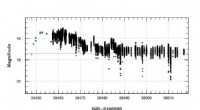
- The explosion, which can be brighter than the entire galaxy for a short time, is what we see as a nova. The outer layers of the white dwarf are ejected into space, creating a glowing shell of gas.
7. Afterglow:
- The nova fades over weeks or months as the expanding gas cools and disperses.
Important Notes:
* White Dwarfs: Novas only occur with white dwarf stars, not other types of stars.
* Recurring Novas: Some novas can be recurring, meaning they erupt multiple times. This happens because the white dwarf continues to accrete material from its companion star.
* Supernovas vs. Novas: Novas are significantly less powerful than supernovas. While supernovas involve the complete destruction of a star, novas are explosions on the surface of a white dwarf.
In essence, a nova is a violent, sudden explosion caused by the thermonuclear fusion of hydrogen on the surface of a white dwarf star, fueled by the accretion of material from a companion star.