1. Parallax:
* Principle: The apparent shift in an object's position when viewed from two different locations. Imagine holding your finger up and looking at it with one eye closed, then the other. Your finger seems to shift relative to the background.
* How it works: Astronomers measure the apparent shift of a star's position as Earth orbits the Sun. The greater the shift (parallax), the closer the star.
* Limitations: Only works for relatively nearby stars (up to a few thousand light-years).
2. Standard Candles:
* Principle: Certain objects in the universe have a known intrinsic brightness (luminosity). By comparing their apparent brightness to their known luminosity, we can estimate their distance.
* Types:
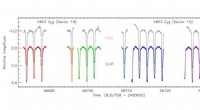
* Cepheid Variables: Pulsating stars with a direct relationship between their pulsation period and luminosity.
* Type Ia Supernovae: Exploding white dwarf stars, which have a consistent peak brightness.
* Limitations: Requires knowing the object's true luminosity, which can be affected by factors like dust absorption.
3. Redshift:
* Principle: As light travels through an expanding universe, its wavelength is stretched, causing it to shift towards the red end of the spectrum (redshift). The amount of redshift is proportional to the object's distance.
* How it works: By measuring the redshift of a galaxy's light, we can estimate its distance.
* Limitations: Based on the assumption of a uniform expansion of the universe.
4. Tully-Fisher Relation:
* Principle: A relationship between the rotation speed of spiral galaxies and their luminosity.
* How it works: By measuring a galaxy's rotation speed, we can estimate its luminosity and then its distance.
* Limitations: Only works for spiral galaxies.
5. Surface Brightness Fluctuation (SBF):
* Principle: Fluctuations in the brightness of individual stars within a galaxy can be used to determine its distance.
* How it works: By measuring the brightness fluctuations and applying statistical analysis, we can estimate the galaxy's distance.
* Limitations: Requires high-resolution imaging and works best for nearby galaxies.
6. Gravitational Lensing:
* Principle: The bending of light around massive objects, causing a distorted image of the source object.
* How it works: The amount of distortion depends on the mass of the lensing object and the distance to both the lens and the source object.
* Limitations: Requires a massive lensing object and accurate knowledge of its mass.
Each of these techniques has its strengths and weaknesses, and astronomers often use a combination of methods to cross-check and refine distance measurements. The quest for accurate distances is ongoing, with new techniques constantly being developed to reach further into the vastness of space.