1. The Birth of a Nebula:
- A giant molecular cloud, a vast expanse of gas and dust, collapses under its own gravity.
- This collapse causes the cloud to rotate and heat up, forming a spinning disk known as the solar nebula.
2. Dust Grains as Seeds:
- Within the nebula, microscopic dust grains, primarily composed of silicates and ices, collide and stick together due to electrostatic forces.
- These tiny particles, called planetesimals, grow through continued collisions and accretion.
3. Formation of Planetesimals:
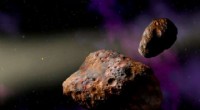
- Planetesimals continue to grow, eventually reaching sizes of kilometers or even hundreds of kilometers.
- These larger bodies have enough gravity to attract more dust and gas, further increasing their size.
4. Differentiation and Accretion:
- As planetesimals grow, they heat up due to collisions and radioactive decay.
- This heat melts the interior, allowing heavier elements like iron and nickel to sink to the core, while lighter elements rise to the surface. This process is called differentiation.
- These differentiated planetesimals continue to accrete material from the surrounding nebula, forming larger bodies.
5. Formation of Planets:
- Over millions of years, the largest planetesimals continue to grow, sweeping up the remaining debris in the solar nebula.
- This process eventually forms the planets we see today.
- The inner planets, closer to the sun, are rocky due to the heat driving away lighter elements, while the outer planets are gaseous, capturing lighter elements like hydrogen and helium.
Additional Factors:
- Gravity: Gravity plays a crucial role in the entire process, pulling matter together and shaping the planets.
- Stellar Wind: The sun's stellar wind eventually clears out the remaining gas and dust from the nebula, leaving behind the planets.
- Planetary Migration: Newly formed planets can migrate through the nebula, sometimes causing gravitational disturbances that affect the orbits of other planets.
Key Points:
- Planet formation is a long and gradual process that takes millions of years.
- The solar nebula provides the raw materials and the initial conditions for the formation of planets.
- Gravity, accretion, and differentiation are key processes involved in planet formation.
Understanding the formation of planets helps us understand the origin of our own solar system and how other planetary systems might form in the universe.