Human Lifespan
* Duration: Measured in decades, with an average of 70-80 years.
* Stages: Birth, childhood, adolescence, adulthood, old age, death.
* Process: Driven by biological processes like cell division, growth, and aging.
* Energy Source: Food, which provides chemical energy.
* End: Death, marking the end of individual life.
* Renewal: Continues through reproduction, passing on genetic information to offspring.
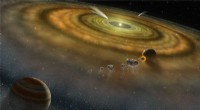
Star Lifespan
* Duration: Measured in millions, billions, or even trillions of years.
* Stages: Protostar, main sequence, giant, supernova (for massive stars), white dwarf, neutron star, or black hole (depending on the star's mass).
* Process: Driven by nuclear fusion, where lighter elements fuse into heavier elements, releasing tremendous energy.
* Energy Source: Nuclear fusion, converting mass into energy.
* End: Depending on the star's mass, it can end as a white dwarf, neutron star, or black hole.
* Renewal: Stars do not "reproduce" in the biological sense. However, the elements created during their lives, including carbon, nitrogen, and oxygen, can be recycled into new stars and planets.
Key Differences
* Timescale: Stars live for vastly longer durations than humans.
* Energy Source: Humans rely on chemical energy, while stars utilize nuclear energy.
* End State: Humans die and their physical bodies decompose. Stars can experience dramatic deaths like supernova explosions or end as compact objects.
* Renewal: Humans reproduce to continue their species. Stars "recycle" their materials, contributing to the formation of new stars and planets.
Similarities
* Both have a beginning and an end: Both human life and star life have a defined lifespan with a beginning and an end.
* Both experience change and transformation: Both human bodies and stars undergo changes and transformations throughout their existence.
Understanding the Differences
It's important to recognize that humans and stars exist on vastly different scales and operate under different physical laws. Understanding these differences helps us appreciate the complexity and interconnectedness of the universe.